4 Documents to Open an Unincorporated Association Bank Account (US)
· 14 min read
Yes, an unincorporated association can open a bank account in the United States, and most banks will approve it if you show up with four things: an EIN, meeting minutes naming your authorized signers, government-issued photo ID for those signers, and an account title that includes your association’s name. Get those right, and the rest is paperwork. One catch worth knowing upfront: your FDIC insurance coverage depends entirely on how that account title is worded.
TL;DR:
- Most banks require an EIN, authorized meeting minutes, government IDs for signers, and an account title including the association’s name for approval.
- Consistent spelling of the association’s name across documents and correct wording of the account title are crucial for FDIC insurance coverage.
- Meeting minutes must explicitly authorize account opening and list signers, as banks rely on this document to verify authority.
- Benefits of the account depend on clear titling; if the account name matches the association and reflects independent activity, FDIC coverage is protected up to $250,000.
- Rejections are often due to name mismatches, vague authorizations, missing documentation, or inconsistent paperwork, which can be fixed with proper preparation.
Table of Contents
- Requirements for Unincorporated Bank Accounts: What to Bring
- How Do Banks Verify Association Identity?
- FDIC Insurance and Account Titling for Associations
- Step-by-Step: How to Apply for an Association Account
- Why Do Banks Reject Association Account Applications?
- Keeping Association Funds Separate and Protected
- What I’ve Seen Go Wrong (And What Actually Fixes It)
- Get Bank-Ready Documents Without the Guesswork
- Where to Verify These Rules Yourself
- Sources
- FAQ
Requirements for Unincorporated Bank Accounts: What to Bring
Think of this as your bank-ready packet. Miss one piece and you’re making a second trip.
Your EIN comes first. An unincorporated association needs an Employer Identification Number to open an account in the group’s name rather than someone’s Social Security number. You apply for free through IRS Form SS-4 online, and the IRS assigns a “responsible party” to the EIN record. That person’s name matters later, so choose someone who’ll actually stay involved.
Meeting minutes or a resolution comes next, and it carries more weight than most people expect. Banks treat this document as the practical stand-in for corporate bylaws. It needs to state, in plain language, that the members authorized opening a bank account and name exactly who can sign for it. A single paragraph works fine: “At a meeting held on [date], the members of [Association Name] voted to open a bank account in the association’s name and authorized [Name, Title] and [Name, Title] as signers on the account.”
A letter of association or a short set of bylaws rounds out your legal documentation. If your group has never formalized anything, a one-page letter describing your purpose, your leadership structure, and your founding date is often enough. Some banks will accept this in place of full bylaws, especially for smaller community groups.
Beyond those three, banks typically require:
- Government-issued photo ID for every authorized signer, and for anyone holding 25% or more control over the association.
- Proof of the association’s address, such as a piece of mail, a lease, or a letter on association letterhead.
- Notarization of the resolution, if the specific bank requests it (not universal, but common at larger institutions).
Dollar Bank’s account opening checklist for unincorporated associations lays out this exact combination, and it mirrors what you’ll find at most regional and national banks.
Formatting matters more than people assume. Scan every document clearly, combine them into a single PDF if you’re applying online, and double check that the association’s name is spelled identically across your EIN letter, your minutes, and your letterhead. Bring originals to the branch when you can. If your group needs help drafting a resolution or bylaws from scratch, our guide on forming an unincorporated association walks through templates you can adapt.
Pro Tip: Print your resolution on association letterhead even if you don’t have official stationery. A simple header with your association’s name, address, and the date signals legitimacy to a bank reviewer faster than a plain text document.
How Do Banks Verify Association Identity?
Banks don’t just take your word for who’s in charge. Federal Customer Due Diligence rules require them to identify the people who actually control an account, and an unincorporated association presents a specific challenge here because there’s no corporate registry, no articles of incorporation, and no state filing that lists officers. The bank has to build that picture from what you hand them.
For most associations, the bank will treat your president, treasurer, or another named officer as the controlling person, or persons, on the account. This is precisely why your meeting minutes matter so much. Without a document naming specific individuals and their authority, a bank has no reliable way to confirm who’s allowed to move association funds.
For each person the bank identifies as a controller or signer, expect to provide:
- Full legal name, date of birth, and residential address.
- Government-issued photo ID (driver’s license or passport).
- Social Security number, for tax reporting purposes.
- Their title or role within the association.
Some banks will also ask each signer to complete a short beneficial-ownership certification form, even though an unincorporated association technically has no “owners” in the corporate sense. This is standard boilerplate compliance, not a sign that something’s wrong with your application.
The way you present your minutes matters as much as the minutes themselves. Don’t just hand over a document; walk the banker through it. Point to the line that authorizes the account, point to the names of the signers, and confirm the date of the meeting matches the resolution. Bankers process dozens of these applications and appreciate when the packet is organized rather than assembled at the last minute. A resolution that clearly delegates authority, dated and signed by whoever ran the meeting, is the fastest way through this step.
FDIC Insurance and Account Titling for Associations
Your deposits are insured up to $250,000, but only if the account title actually says so. Under 12 C.F.R. § 330.11, the FDIC insures deposit accounts held in the name of an unincorporated association separately from any individual member’s personal deposits, up to $250,000, as long as the association is engaged in an “independent activity” and the account title includes the association’s name.
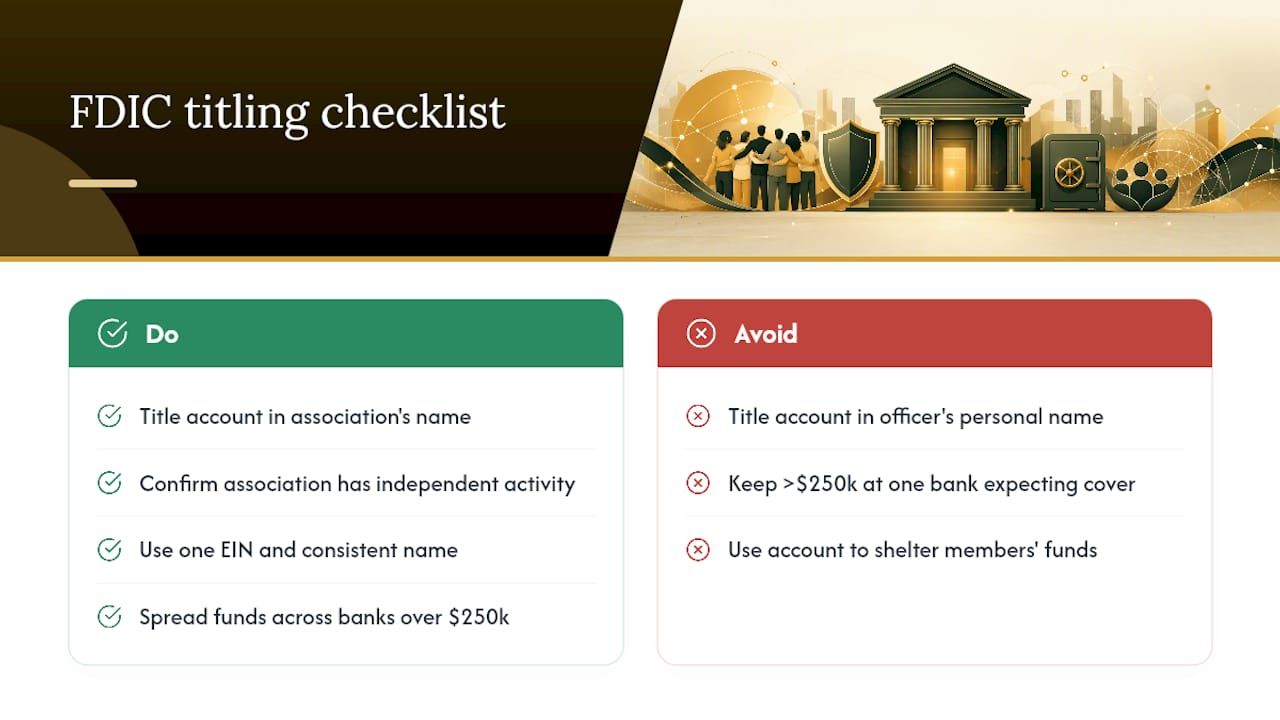
“Independent activity” means the association has its own purpose beyond simply holding money for its members, things like a homeowners group managing dues, a hobby club running events, or a community organization collecting donations. If the FDIC determines the account exists purely to shelter individual members’ personal funds rather than to fund a shared activity, it can aggregate that money with the members’ personal accounts instead of insuring it separately.
Titling is where this gets concrete. “Neighborhood Watch Association” as the account holder qualifies for separate coverage. “John Smith, Treasurer” alone does not; if the account is titled only in an officer’s individual name, the FDIC may treat those funds as personal to that officer, and separate association coverage disappears.
One EIN, one association name, one account title. Consistency there is what keeps your deposit insurance intact.
If your association holds more than $250,000, spreading funds across multiple FDIC-insured banks is your only path to additional coverage. The FDIC aggregates all deposits held under one entity name at a single institution, so opening three accounts at the same bank doesn’t multiply your protection. Opening accounts at three separate banks does.
Step-by-Step: How to Apply for an Association Account
Before you walk into a branch or open a browser tab, assemble your packet. Make two copies of everything, in case the bank keeps one set. Confirm the association name is spelled identically on your EIN letter, your minutes, and any letterhead you’re using; this single check prevents the most common holdup.
- Call ahead or check the bank’s business account page. Ask specifically whether they handle unincorporated association accounts, since not every branch employee will recognize the term immediately.
- Ask for a business accounts specialist, not a general teller. A generalist may not know how to code an unincorporated association in the bank’s system, which slows everything down. Institutions like Bank of America route these requests through business banking specialists rather than personal banking staff, and it’s worth requesting that path directly.
- Describe your group clearly. Say: “We’re an unincorporated association, we have an EIN, and we have meeting minutes authorizing this account and naming our signers.” That sentence alone answers most of a banker’s opening questions.
- Hand over your packet in order: EIN letter first, minutes second, IDs third, proof of address last.
- If applying online, upload documents as separate labeled PDFs (EIN letter, minutes, IDs) rather than one combined scan; many bank portals process single-purpose uploads faster and flag fewer manual reviews.
Timelines vary, but banks commonly set an internal window of seven to fourteen days to receive any missing documentation before they close out an incomplete application. If everything’s in order at the branch, many associations walk out with a functioning account and temporary checks the same day; debit cards and permanent checks typically arrive by mail within one to two weeks.
If the bank asks for something extra, don’t guess at what satisfies them. Ask for a written list of exactly what’s missing. That single request turns a vague delay into a solvable checklist.
Pro Tip: Smaller community banks and credit unions often accept meeting minutes on plain letterhead and move faster on unincorporated association accounts than large national chains, which tend to apply stricter, more standardized documentation rules. Calling two or three options before you commit can save a week of back and forth.
Why Do Banks Reject Association Account Applications?
Most rejections trace back to one of five fixable problems.
- Name mismatch between your EIN letter and your minutes. This is the single most common failure point. Fix it by amending your minutes to match the EIN exactly, or by contacting the IRS to correct the name on file if the EIN itself has the error.
- Vague or missing authorization language. If your minutes say the group “discussed opening an account” without explicitly authorizing it and naming signers, that’s not enough. Use direct language: “The members voted to authorize [names] to open and manage a bank account on behalf of [Association Name].”
- Missing beneficial-owner information. Banks need ID and basic personal information for every signer and controlling person. Gather this before your appointment rather than promising to “send it later.”
- No bylaws or founding documentation at all. If your group has never written anything down, a simple one-page letter of association, describing your purpose and leadership, drafted and signed the same day as a quick organizational meeting, is usually enough to move forward.
- A flat decline with no clear reason. Ask the branch for a written explanation. If none is given, escalate to the branch manager, or take your packet to a community bank or credit union, which often applies more flexible standards than a large national chain.
Keeping Association Funds Separate and Protected
Mixing personal and association money is how personal liability protection quietly disappears; legal guidance on “piercing the corporate veil” applies the same underlying logic to unincorporated associations that fail to keep clean financial boundaries.
- Keep minutes, resolutions, and bylaws in one backed-up folder, digital and physical, and sign or timestamp every meeting record.
- Route every dollar of association business through the association account. Nothing personal goes in, nothing association-related goes out through a member’s personal account.
- Require two-person approval for transfers above a set threshold, even if that just means two officers texting confirmation before a wire goes out.
- File IRS Form 8822-B whenever your officers change, since the IRS “responsible party” on record needs updating, and an outdated record creates headaches with both the IRS and your bank later.
Pro Tip: Reconcile the account monthly, even for a small association. It’s the cheapest insurance policy against both fraud and simple bookkeeping drift. Our piece on reducing taxes as a private unincorporated association covers recordkeeping habits that pair well with this.
What I’ve Seen Go Wrong (And What Actually Fixes It)
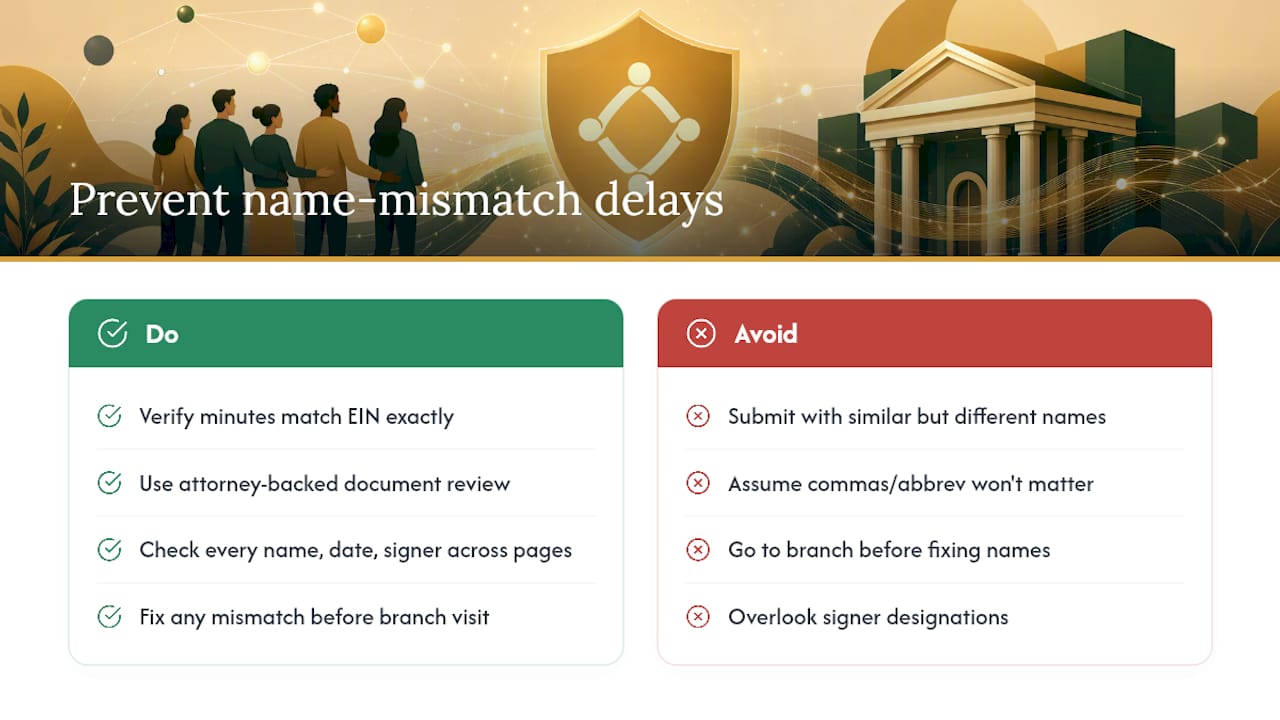
Name mismatches cause more delays than anything else on this list. An association calls itself one thing on its letterhead and something slightly different on its EIN record, and the whole application stalls over a comma or an abbreviation.
Attorney-backed documentation solves this before it starts, because someone experienced checks that every name, date, and signer designation lines up across every page before you ever walk into a branch. The one thing I always verify before a branch visit: does the association name on the minutes match the EIN letter character for character? If not, fix that first. Everything else in the packet is secondary.
— David
Get Bank-Ready Documents Without the Guesswork
Some services provide attorney-backed formation documents built to match what banks expect: meeting minutes with proper authorization language, a letter of association, naming consistency across your EIN and paperwork, and ongoing support if a banker asks a question you can’t answer on the spot.
That last piece matters more than it sounds. A DIY resolution template pulled from a generic website often gets close, but “close” is exactly what triggers a second branch visit. The UNA + ROE package includes state registration, EIN assignment, and a Revocation of Election filing prepared alongside your governance documents, so your name, your signers, and your entity paperwork are consistent from day one rather than patched together after a rejection. When evaluating any paid documentation service, ask three questions: is an attorney actually involved in drafting, are revisions included if a bank asks for a change, and is there ongoing support if you get stuck at the counter. If you’d rather talk through your specific situation first, you can book a free 15-minute call to see whether a UNA fits your group before you commit to anything.
Where to Verify These Rules Yourself
Check the FDIC’s guidance on association accounts, the IRS EIN application page, and your chosen bank’s own account-opening checklist before you apply.
Sources
- Unincorporated Association/Organization Account Opening checklist
- Corporation, Partnership and Unincorporated Association Accounts | FDIC
FAQ
Can an Unincorporated Association Open a Bank Account?
Yes. An unincorporated association can open a bank account by providing an EIN, meeting minutes naming authorized signers, government ID for those signers, and an account title that includes the association’s name.
Is There a Free Bank Account Option for Nonprofit Organizations?
Many banks and credit unions offer free or low-fee checking accounts for nonprofit and association clients, though availability and fee waivers vary by institution, so it’s worth comparing a few local banks and credit unions directly.
What Are the Disadvantages of an Unincorporated Association?
The main drawback is personal liability exposure for members and officers, since the group has no separate legal shield the way a corporation or LLC does, which makes strict fund separation and clean governance records especially important.
Do Unincorporated Associations Need to Be Registered?
No state filing is required to form an unincorporated association, but you still need an EIN from the IRS and internal governance documents, like meeting minutes and a letter of association, to open a bank account and operate with any credibility.
Does FDIC Insurance Cover Unincorporated Association Accounts?
Yes, up to $250,000, but only when the account title includes the association’s name and the association engages in an independent activity separate from simply holding members’ personal funds.
Recommended
Have questions? Bring them to the daily call.
Join our live Q&A every weekday and Saturday at 3PM PST, or get a free 15-minute call to see whether a UNA fits your situation.
Have a question about your situation?
Send us a message and we'll get back to you.
Keep reading
 The Well-Meaning Dragon: Straight Answers to the Hardest ObjectionsFor the family and friends who push back because they care — honest answers to the toughest questions about the Federal income tax and Unincorporated Associations.
 It's Not What You Believe, It's What You SignFor the cautious partner in the room: real risk rarely comes from asking questions. It comes from what you signed.
 What Most People Get Wrong About Taxes, Structure, and ControlThe real problem isn't taxes — it's structure, and who actually has control. A look at positioning over loopholes.
Educational, not legal or tax advice. Unincorporated Associations is a document-preparation and education company. Consult a licensed attorney or CPA before acting on any position discussed on this site.