Instant EIN and Bank Ready SS-4 for U.S. Unincorporated Associations
· 12 min read
Yes, an unincorporated association can get an EIN, and the IRS treats the request no differently than any other entity’s. Your group needs one the moment it opens a bank account, hires anyone, or applies for tax-exempt status. The Internal Revenue Service issues EINs as federal tax IDs, free of charge. Apply online for an instant number, or prepare Form SS-4 first if you plan to fax or mail it.
TL;DR:
- Unincorporated associations must obtain an EIN immediately if they plan to hire employees, open a bank account, or apply for tax-exempt status.
- The fastest way to get an EIN is through the online IRS tool, which requires a responsible party with a U.S. taxpayer ID and a same-session completion.
- Most associations should prepare accurate legal name, responsible party’s SSN or ITIN, and clearly state their organization purpose on Form SS-4 to avoid delays.
- Banks typically require the EIN confirmation letter, governing documents, officer resolution, and ID, with preferences varying between community banks and large banks.
- Getting an EIN does not incorporate the group; for liability protection or grant purposes, formal incorporation may be advantageous before or after applying.
Table of Contents
- How Do You Apply for an EIN for an Unincorporated Association?
- Who Actually Needs an EIN?
- How Do You Fill Out Form SS-4 for an Unincorporated Association?
- What Documents Do Banks Require to Open an Account?
- Should You Incorporate First or Get an EIN Now?
- Why Attorney-Backed Formation Reduces EIN and Banking Friction
- Get EIN-Ready Documents Built to Clear Bank Review the First Time
- Sources
- FAQ
How Do You Apply for an EIN for an Unincorporated Association?
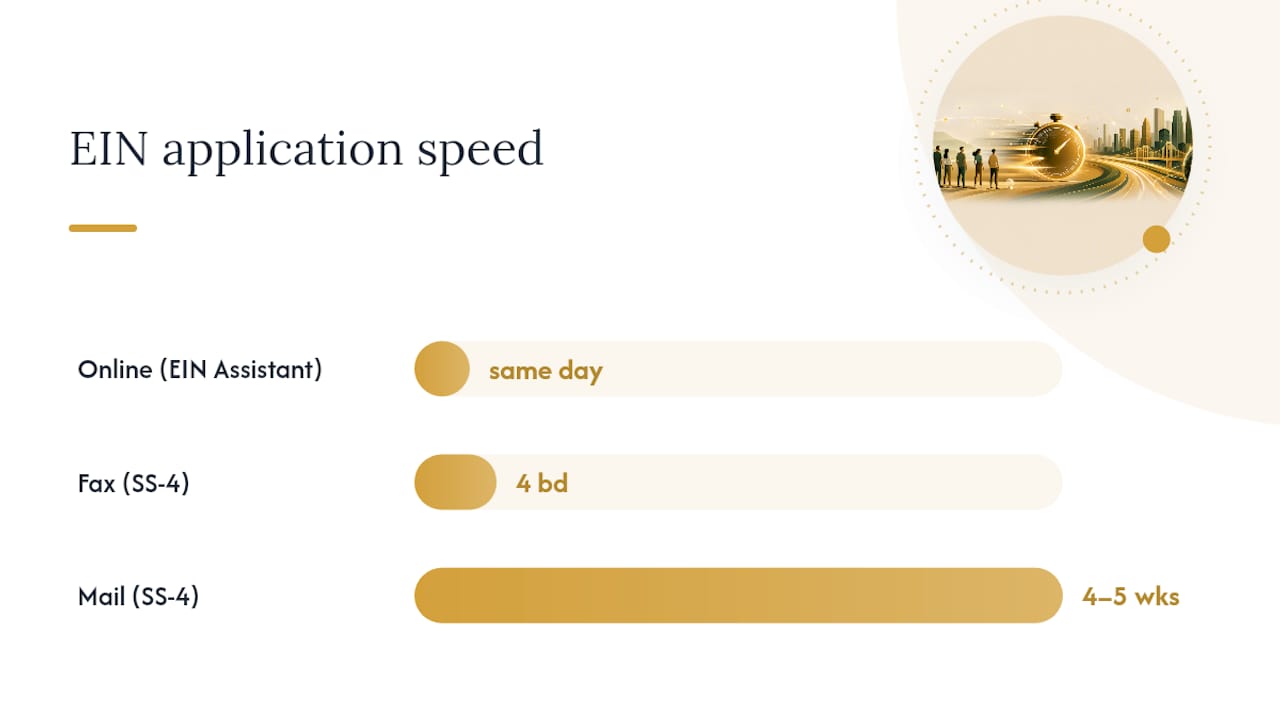
You have four paths: online, fax, mail, or phone. Only one of them gives you a number today.
The IRS Online EIN Assistant is the fastest route for almost every U.S.-based association. You fill out a short interview, and the system assigns your EIN the moment you finish, no waiting period, no confirmation email delay. There’s a catch worth knowing before you start: the tool requires your “responsible party” to already have a valid Social Security Number or ITIN, and the session must be completed in one sitting or it times out and resets. If your treasurer or founding officer doesn’t have a U.S. taxpayer ID, this option is closed to you.
Faxing Form SS-4 is the next best option. Processing typically runs about four business days, faster than mail, slower than online. Mail applications can take four to five weeks depending on the processing center’s backlog. Whichever paper method you choose, attach a short explanatory note stating “Unincorporated association” as your entity type. That single line prevents a lot of the classification confusion the IRS sees with community groups, churches, and volunteer organizations.
Phone applications exist, but they’re reserved for international applicants without a U.S. legal residence. If you’re organizing a neighborhood association, alumni group, or grassroots nonprofit inside the United States, you won’t need this option.
Before you sit down to file, gather this information:
- The association’s official name, exactly as it appears in your bylaws or constitution.
- A mailing address where IRS correspondence should go.
- The name and SSN or ITIN of your responsible party (usually a founding officer or board chair).
- The date the association started or was organized.
- Your reason for applying (banking, hiring employees, or preparing to file for tax-exempt status).
Pro Tip: Save the CP 575 confirmation notice (or the confirmation letter you receive after a phone or fax application) somewhere permanent. Banks will ask for it, and reordering a lost EIN letter from the IRS can take weeks.
Skipping this paperwork isn’t really an option if your association ever wants to touch institutional money. Failing to separate the group’s finances from a founder’s personal accounts is one of the more common ways members expose themselves to liability, and a dedicated EIN with its own bank account is the first real firewall against that.
Who Actually Needs an EIN?
Some associations need an EIN immediately. Others can operate informally for a while. The distinction usually comes down to money and people.
You need an EIN now if your association:
- Plans to hire employees or pay payroll taxes
- Owes federal excise taxes
- Sponsors a retirement plan for staff
- Wants to open a bank account under the association’s name rather than a member’s personal account
- Intends to accept tax-deductible donations
- Is preparing to file Form 1023 or Form 1023-EZ for 501©(3) status
Think about three groups side by side. A book club that meets at members’ houses and never touches outside money probably doesn’t need an EIN yet. A community charity collecting donations for a local food pantry needs one immediately, both to open an account and to eventually apply for exemption. An association that has grown enough to hire a part-time coordinator needs an EIN the day that first paycheck is issued, no exceptions.
The IRS actually requires the EIN to appear on your Form 1023 application before it will process a request for tax-exempt status, so groups planning to seek 501©(3) recognition should treat the EIN as step one, not an afterthought.
How Do You Fill Out Form SS-4 for an Unincorporated Association?
Most delays trace back to a handful of fields on Form SS-4. Get these right and your application moves cleanly.
Line 1 (legal name): Use the exact name from your bylaws or founding document, not a shortened nickname the group uses casually. If you operate under a “doing business as” name, list your legal name here and note the DBA separately if the form allows it.
Line 7b (responsible party): This is typically a founding officer, board chair, or treasurer who has authority over the association’s funds and records. That person needs a valid SSN or ITIN. If nobody in leadership has one, you’ll need to resolve that before applying online and may need to route through fax or mail instead.
Line 9a (entity classification): This is where most unincorporated associations stumble. Many practitioners recommend checking “Other nonprofit organization” and writing “Unincorporated association” in the explanation field, according to guidance from tax practitioners who work with community groups. That explicit wording tells the IRS exactly what kind of entity is applying and cuts down on requests for follow-up documentation.
For your start date and principal activity, keep the wording plain: “Organized [month, year] to operate as a volunteer community association” works better than vague or overly legal phrasing.
Here’s the sequence once you submit:
- Submit SS-4 online, by fax, or by mail.
- Receive your EIN immediately (online) or your CP 575 confirmation letter within days to weeks (fax or mail).
- File that confirmation letter with your bylaws and meeting minutes. It’s part of your association’s permanent record now.
Pro Tip: Keep a digital and physical copy of your CP 575 in the same folder as your bylaws. Banks and grant applications will ask for both together more often than you’d expect.
What Documents Do Banks Require to Open an Account?
Getting the EIN is only half the job. Banks won’t hand an unincorporated association a checking account on the strength of a tax number alone.
Expect to bring:
- Your EIN confirmation letter (CP 575 or the IRS notice)
- Governing documents: bylaws or a constitution showing the association exists and how it’s run
- A signed officer resolution naming who’s authorized to open and manage the account
- Photo identification for each authorized signer
- Any state-level DBA filing or registration, if your bank asks for one
Bank practices vary more than you’d guess. Community banks tend to accept an EIN letter and bylaws with minimal fuss. Larger national banks sometimes request state-level proof of registration even for a group that’s legally unincorporated, simply because their onboarding software wasn’t built with informal associations in mind. Calling ahead with your document checklist saves a wasted trip.
The FDIC’s guidance on account titling matters more than most organizers realize. How an account is titled affects how deposit insurance applies to it. An account titled correctly under the association’s legal name and EIN, rather than mixed in with a personal account, is what keeps those funds properly insured and properly separated for liability purposes.
Should You Incorporate First or Get an EIN Now?
Getting an EIN doesn’t change your legal structure. You’re still an unincorporated association after the IRS assigns your number. That surprises a lot of first-time organizers who assume the EIN itself confers some kind of legal status.
Incorporating first has real advantages: liability protection for individual members, and often a clearer standing with grant-making foundations that prefer working with formally recognized entities. Getting the EIN now, without incorporating, gets you banking access, hiring capability, and a path toward tax-exempt filing faster.
If you do incorporate later, you’ll typically need a new EIN, since the IRS generally treats incorporation as forming a new legal entity distinct from the unincorporated group that came before it.
Run through this before deciding:
- Do you need a bank account in the next few weeks? Get the EIN now.
- Do you plan to hire staff within the year? Get the EIN now.
- Are you chasing major grants or large donors who expect formal incorporation? Consider incorporating first.
- Is member liability protection your top concern? Incorporating addresses that directly; an EIN alone doesn’t.
Why Attorney-Backed Formation Reduces EIN and Banking Friction
Most of the friction associations hit isn’t with the IRS. It’s with banks asking for one more document, or with founders realizing mid-application that their bylaws don’t match what the SS-4 form expects. Attorney-backed governing documents, a properly worded bank resolution, and guidance on naming tend to eliminate that back-and-forth before it starts.
This matters most for associations handling complex asset transfers, active fundraising, or anyone planning to bring on staff. A two-person social club filing its own SS-4 is a reasonable DIY project. A charity managing donations and preparing for 501©(3) status benefits from documents built to survive a bank’s compliance review the first time.
— Kirk Carmichael
Get EIN-Ready Documents Built to Clear Bank Review the First Time
Unincorporated Associations is the alternative to piecing together bylaws, resolutions, and SS-4 language on your own, with attorney-backed documents built specifically to satisfy the paperwork banks and the IRS actually ask for.
The UNA + ROE package includes governing documents, a bank-ready officer resolution, EIN application assistance, and naming review, everything a bank compliance officer looks for when an unincorporated group walks in asking to open an account. It’s built for associations managing donations, planning to hire, or transferring assets into member-based governance rather than a traditional LLC or corporate structure. Groups without those complications can often handle the DIY steps above just fine.
If your association is past the simple stage, book a free 15-minute call to walk through what your paperwork needs before you approach a bank or file with the IRS.
Sources
Confirm application procedures directly through the IRS guidance on obtaining an EIN for exempt organizations. Review deposit insurance and titling rules through FDIC guidance for unincorporated groups. For general federal agency contacts, Usa is the central directory.
This article is general information, not a substitute for advice from a qualified financial advisor. Consult a qualified financial professional about your own circumstances before acting on anything here.
- Can an Unincorporated Association Get an EIN? + FAQs
- FDIC: Corporation, partnership and unincorporated
FAQ
Do unincorporated associations need to be registered?
No federal registration is required to exist as an unincorporated association, though some states require filings if you seek certain protections or intend to hold property. An EIN application doesn’t require state registration first.
Do unincorporated associations have to file taxes?
Yes, in most cases. Unless the association qualifies for and obtains tax-exempt status, it generally owes federal income tax on its net earnings, which is another reason to secure an EIN early.
Can an unincorporated association be a 501©(3)?
Yes. An unincorporated association can apply for 501©(3) status by filing Form 1023 or 1023-EZ, but the IRS requires the EIN to already be assigned before that application can be processed.
What is an unincorporated nonprofit association?
It’s a group of two or more people joined together for a common nonprofit purpose without filing formal incorporation papers with a state. It can still obtain an EIN, open bank accounts, and pursue tax-exempt recognition despite lacking corporate status.
Recommended
- Order Your UNA + ROE Package — $4,950
- Order Your UNA + ROE Package — $4,950
- Order Your UNA + ROE Package — $4,950
- Order Your UNA + ROE Package — $4,950
This article is provided for general informational and educational purposes only and does not constitute legal, tax, accounting, or financial advice. Reading this content or contacting UnincorporatedAssociations.com does not create an attorney-client, CPA-client, or other professional-client relationship. In accordance with IRS Circular 230, any discussion of federal tax matters herein is not intended or written to be used, and cannot be used, for the purpose of avoiding penalties.
Have questions? Bring them to the daily call.
Join our live Q&A every weekday and Saturday at 3PM PST, or get a free 15-minute call to see whether a UNA fits your situation.
Have a question about your situation?
Send us a message and we'll get back to you.
Keep reading
 The Well-Meaning Dragon: Straight Answers to the Hardest ObjectionsFor the family and friends who push back because they care — honest answers to the toughest questions about the Federal income tax and Unincorporated Associations.
 It's Not What You Believe, It's What You SignFor the cautious partner in the room: real risk rarely comes from asking questions. It comes from what you signed.
 What Most People Get Wrong About Taxes, Structure, and ControlThe real problem isn't taxes — it's structure, and who actually has control. A look at positioning over loopholes.
Educational, not legal or tax advice. Unincorporated Associations is a document-preparation and education company. Consult a licensed attorney or CPA before acting on any position discussed on this site.