
Protect Your Assets in the U.S.: 7 Steps to Move an LLC Into a Trust
· 12 min read

Use an LLC when you need liability separation for an active business or rental property. Use a trust when your goal is a smooth transfer, probate avoidance, and controlled distribution of what you own. Most owners with real assets to protect eventually use both, with a trust holding the LLC membership interest, but that combination only works if the operating agreement allows it and a tax professional signs off first.
TL;DR:
- An LLC provides liability protection for active businesses and rental properties, but only if properly formed, operated, and maintained according to legal rules.
- A trust, especially an irrevocable one, offers asset transfer and probate advantages, but does not shield assets from creditors unless combined with an LLC.
- Combining an LLC and a trust allows most owners to protect operational liabilities while ensuring assets pass smoothly to beneficiaries without probate.
- An LLC can be owned by a trust, passing ownership directly to heirs and avoiding probate, but requires careful legal and tax consideration beforehand.
- A private unincorporated association offers privacy and flexible governance without ongoing state fees, serving as an alternative ownership vehicle in certain cases.
Table of Contents
- What Is an LLC and What Does It Actually Protect?
- What Is a Trust and How Does It Differ From a Will?
- LLC vs Trust: Liability, Probate, Taxes, and Cost Compared
- When Should You Choose an LLC, a Trust, or Both?
- Can a Trust Own an LLC? How the Two Combine
- Tax and Reporting Rules for LLC-Trust Structures
- How to Transfer an LLC Interest Into a Trust: A Step-by-Step Checklist
- What Estate Attorneys Wish More Clients Knew
- A Different Ownership Framework Worth Knowing About
- Sources
- FAQ
What Is an LLC and What Does It Actually Protect?
An LLC is a business entity that shields owners from business-related liabilities, keeping a lawsuit against the business from reaching your personal bank account or home. That’s the whole pitch, and it’s a good one, but it only holds if you respect the structure.
You form an LLC by filing with your state, then governing it through an operating agreement that spells out who manages what. Members can run it themselves or hand day-to-day control to a manager. Skip that paperwork, mix personal and business funds, or ignore your own agreement, and a court can “pierce the veil,” exposing you personally anyway.
Where does an LLC actually shine?
- Active businesses with employees, contracts, and customer-facing risk
- Rental properties, where tenant injuries or property disputes are a real possibility
- Multi-partner ventures that need a clear governance structure
Ongoing obligations include annual state reports, renewal fees, and registered-agent requirements. If a creditor does come after a member personally, many states limit that creditor’s remedy to a charging order, which generally allows them to claim distributions if the LLC pays any out, but typically they cannot force a sale of the business or seize a management seat.
What Is a Trust and How Does It Differ From a Will?
A trust is a fiduciary arrangement to manage and transfer assets under written rules, built specifically to sidestep the probate court process that wills go through. Three roles matter here: the grantor who creates it, the trustee who manages it, and the beneficiaries who eventually receive it.
The revocable living trust is the workhorse of everyday estate planning. You keep full control, can amend or dissolve it anytime, and your assets pass to heirs without a judge’s involvement. What it does not do is protect assets from your own creditors. Courts routinely treat a revocable trust as your alter ego for collection purposes, since you can revoke it at will.
An irrevocable trust trades that flexibility for real protection. Once assets go in, you generally can’t take them back, which is exactly why creditors usually can’t reach them either. That trade comes with strings attached:
- You give up direct control over the assets
- Transfers can trigger gift tax reporting
- Amendments are difficult or impossible once signed
Most families use trusts to avoid probate delays, keep an inheritance private, and stagger distributions to heirs over time rather than handing over a lump sum at 18.
LLC vs Trust: Liability, Probate, Taxes, and Cost Compared
An LLC and a trust solve two different problems, and confusing them is the single most common mistake people make in this space. The LLC absorbs operational risk. The trust handles what happens to your ownership stake when you die or can’t manage it yourself. Combining a trust and an LLC layers those protections, with the LLC providing liability separation while the trust enables probate avoidance and controlled succession.
Here’s how the two stack up on the factors that actually drive the decision:
- Liability exposure: LLC shields personal assets from business debts; a revocable trust offers none, and only an irrevocable trust adds meaningful protection.
- Probate: LLC membership interests still pass through probate unless a beneficiary designation or trust intervenes; a trust bypasses probate entirely.
- Taxes: Both can be tax-neutral pass-throughs, but the paperwork differs sharply, covered below.
- Cost and complexity: LLCs carry ongoing state filing fees; trusts cost more upfront to draft properly but have minimal annual upkeep.
- Best-fit assets: LLCs suit rentals and active businesses; trusts suit personal assets, family wealth, and anything meant for the next generation.
Pro Tip: Don’t pick a structure by asking “which saves more on taxes?” That question comes second. Ask first which problem, liability or succession, actually keeps you up at night.
When Should You Choose an LLC, a Trust, or Both?
The right structure follows the actual risk you’re worried about, not the one that sounds more sophisticated at a dinner party.
If your exposure comes from third parties, a slip-and-fall tenant, an unhappy customer, a business partner’s mistake, lean LLC. That’s a liability problem, and liability problems need liability tools.
If your exposure comes from probate delays, incapacity planning, or wanting heirs to receive money on a schedule instead of all at once, lean trust. No LLC in the world solves that.
If you need both an operational shield and a clean succession plan, and this describes most landlords and family business owners eventually, combine them. Put the rental or business inside the LLC, then have a trust hold the membership interest.
Before deciding, run through this quick check:
- Do other members or partners need to consent to a transfer?
- Does your operating agreement already restrict who can hold interests?
- Is the asset itself (real estate, a business, cash) suited to one wrapper over the other?
- Are you solving a probate problem, a liability problem, or both?
One tax attorney’s caution is worth repeating here: choosing a structure primarily for tax reasons is often a mistake. Risk management and continuity should drive the decision, not the tax line.
Can a Trust Own an LLC? How the Two Combine
Yes, and it’s more common than most owners realize. The Revised Uniform Limited Liability Company Act, adopted in some form in most states, treats trusts as “persons” eligible for LLC membership, meaning a trust can legally hold a membership interest just like an individual can.
Why bother? Because it solves the probate gap. Without this move, your LLC interest is a personal asset that has to go through probate court like anything else you own outright. Route it through a trust instead, and it passes to your beneficiaries automatically.
A few practical wrinkles show up here:
- Your operating agreement may restrict transfers or require unanimous member consent before a trust is admitted
- A transferee that isn’t formally admitted may become an assignee only, meaning economic rights with no voting power
- The trust document itself needs explicit language granting the trustee authority to manage or vote the LLC interest
Pro Tip: An irrevocable trust holding a single-member LLC can actually convert it into something courts treat like a multi-member LLC for creditor-remedy purposes, which is a meaningful upgrade in protection that a revocable trust simply doesn’t offer.
Tax and Reporting Rules for LLC-Trust Structures
Tax treatment hinges on structure, not intent, and getting it wrong can cost you an election you didn’t mean to lose.
A single-member LLC is typically a disregarded entity, meaning its income flows straight to the owner’s return with no separate filing. When a grantor trust owns that LLC, the same disregarded treatment usually carries through since tax classification depends on the number of members and the trust type.
A multi-member LLC defaults to partnership taxation, filing Form 1065 and issuing Schedule K-1s to each member. If a trust is one of those members, the trust itself may need to file Form 1041.
Two more rules worth flagging before you transfer anything:
- S-election risk: not every trust type qualifies as an eligible S corporation shareholder, and using the wrong one can terminate S status entirely.
- Gift tax exposure: moving an LLC interest into an irrevocable trust can count as a taxable gift.
For 2026, gift and estate tax exemption thresholds determine whether that transfer triggers a filing requirement or actual tax. Confirm current figures with a tax professional before you sign anything, since these thresholds shift.
How to Transfer an LLC Interest Into a Trust: A Step-by-Step Checklist
- Read the operating agreement first. Look specifically for transfer restrictions, rights of first refusal, and consent requirements.
- Get member consent or amend the agreement. If other members exist, silence in the document doesn’t mean you can skip this.
- Execute a formal assignment of membership interest naming the trust and trustee explicitly.
- Update company records. Amend the membership ledger, and confirm the change is reflected anywhere the ownership is recorded.
- Update the EIN, bank accounts, and contracts tied to the LLC so they reflect the new ownership record.
- Confirm trustee authority language exists in the trust document itself, not just implied by the assignment.
- Consult tax counsel before finalizing, particularly if an S-election, gift tax exposure, or an irrevocable trust is involved.
What Estate Attorneys Wish More Clients Knew
The pitfalls repeat themselves: ignoring the operating agreement, assuming a revocable trust protects assets from creditors, and vague trustee authority language that causes headaches later.
Review your documents, get member signoff in writing, and loop in tax counsel before you transfer anything.
— Kirk Carmichael
A Different Ownership Framework Worth Knowing About
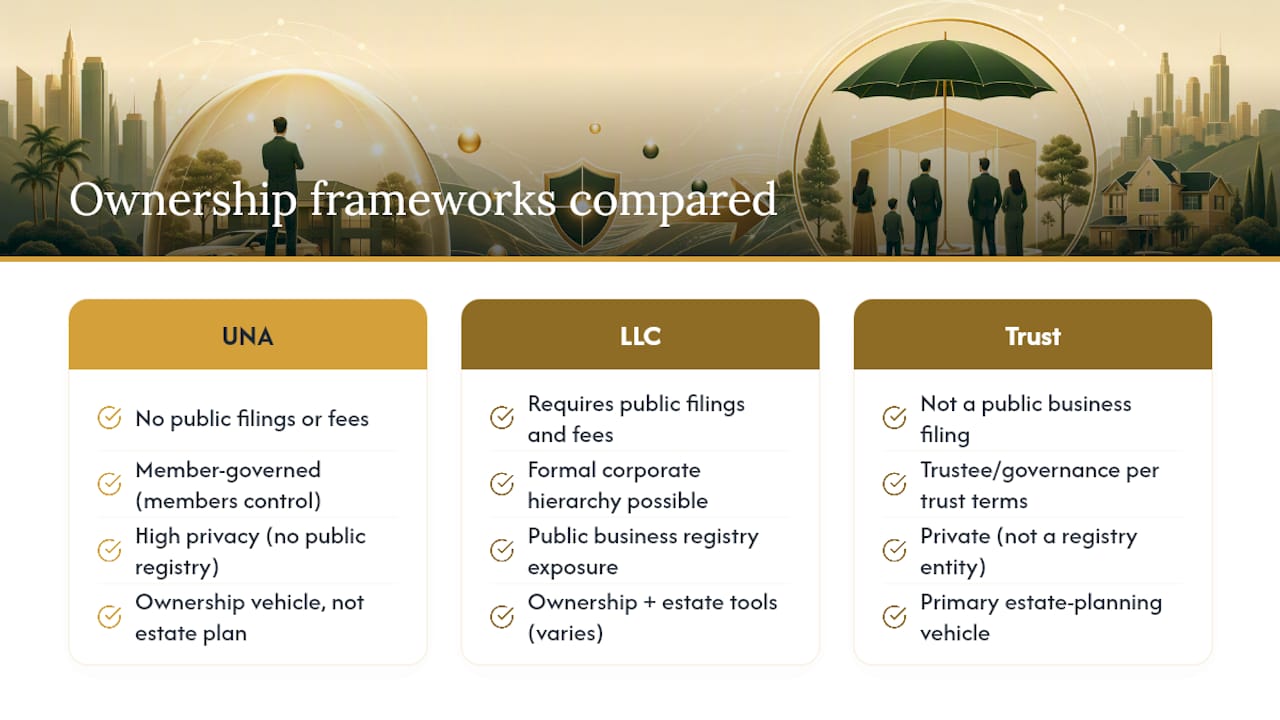
If the LLC-and-trust combination still leaves you filing annual reports, paying state fees, and appearing in a public business registry, you have another option worth understanding. A Private Unincorporated Association, or UNA, is a member-governed structure that lets you hold and control assets without the public filings, franchise taxes, or renewal fees that come standard with an LLC.

They offer attorney-backed documentation, customizable association naming, and ongoing support. A UNA tends to fit readers who want the privacy an LLC’s public registry doesn’t offer, along with member-based governance instead of a formal corporate hierarchy. It won’t replace a trust’s role in estate planning, but as an ownership vehicle, it solves a different set of frustrations than either an LLC or a trust addresses on its own.
If you’re weighing the tax mechanics of a disregarded entity against a UNA’s approach, this breakdown of UNA tax strategy walks through the difference. Ready to see whether it fits your situation? Start the formation process or speak with an advisor before you commit to another year of LLC renewal fees.
This article is general information, not a substitute for advice from a qualified lawyer. Consult a qualified legal professional about your own circumstances before acting on anything here.
Sources
- LLC vs Trust
- Can You Put a Trust in an LLC? Steps and Tax
- The misconception of asset protection with revocable living trusts
FAQ
What Are the Disadvantages of a Trust?
A revocable trust offers no creditor protection since courts treat it as your alter ego, and irrevocable trusts require giving up direct control over the assets, plus potential gift tax reporting.
Does an LLC Avoid Inheritance Tax?
No. An LLC does nothing on its own for estate or inheritance tax; it shields liability, not transfer tax exposure, so the interest still needs a trust or other plan to avoid probate and manage tax consequences.
If My Trust Owns My LLC, Do I Still Have to Pay Taxes on It?
Yes, in most cases. A revocable or grantor trust typically means the income still flows to your personal return since the LLC remains a disregarded entity for tax purposes.
Why Would a Trust Own an LLC?
A trust holding an LLC membership interest lets that ownership pass to your beneficiaries without going through probate, while the LLC continues shielding the underlying business or rental from personal liability.
Which Is Better, an LLC or a Trust?
Neither is universally better since they solve different problems. An LLC is a liability tool for active businesses, and a trust is a transfer tool for estate planning, so many owners in the U.S. eventually use both together.
Recommended
- How a Private Unincorporated Association Can Reduce Taxes
- How to Become an Unincorporated Association
This article is provided for general informational and educational purposes only and does not constitute legal, tax, accounting, or financial advice. Reading this content or contacting UnincorporatedAssociations.com does not create an attorney-client, CPA-client, or other professional-client relationship. In accordance with IRS Circular 230, any discussion of federal tax matters herein is not intended or written to be used, and cannot be used, for the purpose of avoiding penalties.
Have questions? Bring them to the daily call.
Join our live Q&A every weekday and Saturday at 3PM PST, or get a free 15-minute call to see whether a UNA fits your situation.
Have a question about your situation?
Send us a message and we'll get back to you.
Keep reading
 The Well-Meaning Dragon: Straight Answers to the Hardest ObjectionsFor the family and friends who push back because they care — honest answers to the toughest questions about the Federal income tax and Unincorporated Associations.
 It's Not What You Believe, It's What You SignFor the cautious partner in the room: real risk rarely comes from asking questions. It comes from what you signed.
 What Most People Get Wrong About Taxes, Structure, and ControlThe real problem isn't taxes — it's structure, and who actually has control. A look at positioning over loopholes.
Educational, not legal or tax advice. Unincorporated Associations is a document-preparation and education company. Consult a licensed attorney or CPA before acting on any position discussed on this site.