6 Questions to Choose Between Nonprofit and Not for Profit in the U.S.
· 11 min read
In U.S. practice, “nonprofit” usually points to public-benefit charities, often 501©(3) organizations, while “not-for-profit” tends to describe member-focused groups like sports clubs or hobby associations. Both types reinvest every dollar of surplus back into their mission and answer to no private owners. The IRS files them all under the 501© umbrella, but tax treatment, donor deductibility, and reporting obligations diverge sharply. Here’s what actually separates them, and how to pick the right structure.
TL;DR:
- The critical distinction is their IRS classification: only 501©(3) nonprofits offer donor tax deductions and face heavier public disclosure, while most not-for-profits fall under different subsections like 501©(7) or 501©(4), which have fewer reporting requirements.
- Both structures involve no private ownership and reinvest surplus funds into their missions, but nonprofits are almost always incorporated at the state level, whereas not-for-profits might remain unincorporated, affecting liability and legal protections.
- Filing Form 1023 or 1023-EZ is necessary for 501©(3) recognition, a process that typically takes months, and failure to meet governance or reporting standards risks losing tax-exempt status.
- The choice between nonprofit and not-for-profit depends on organizational purpose, funding sources, liability concerns, and governance style, not on the label used.
- Regardless of labels, organizations that call themselves “not-for-profit” can still qualify for tax exemption un der other subsections, and transparency through Form 990 public disclosures helps build donor trust.
Table of Contents
- Nonprofit or Not for Profit: A Side-by-Side Look
- IRS Rules That Actually Decide Your Tax Status
- Who Owns a Nonprofit? Nobody, and That’s the Point
- Form 990 and the Transparency Gap Donors Notice
- Choosing Between Nonprofit and Not-for-Profit: Your Checklist
- Compliance Mistakes That Put Your Status at Risk
- Why the Words You Use Actually Matter
- An Attorney-Backed Path Beyond the Standard Nonprofit Model
- Where to Verify These Rules Yourself
- Sources
- FAQ
Nonprofit or Not for Profit: A Side-by-Side Look
The terms overlap in casual conversation, but the differences between nonprofit and not-for-profit organizations show up the moment you look at taxes, governance, and public reporting.
- Purpose. Nonprofits generally exist for public benefit (feeding the hungry, funding research, running a museum). Not-for-profits often serve their own members (a golf club, a fraternity, a hobbyist league).
- Donor tax treatment. Gifts to a 501©(3) nonprofit are typically tax-deductible for the donor. Contributions to many not-for-profit categories, like a 501©(7) social club, usually are not.
- Common IRS mapping. “Nonprofit” tends to align with 501©(3) public charities, while “not-for-profit” often maps to sections like 501©(4) or 501©(7).
- Transparency. Nonprofits generally face heavier public disclosure requirements, since most must file Form 990 every year. Many not-for-profits carry lighter reporting duties.
- Formation style. Nonprofits are almost always incorporated with a state. Not-for-profit groups sometimes stay unincorporated, trading legal protection for simpler paperwork.
None of this is codified as an official IRS split. The agency does not use “nonprofit” or “not-for-profit” as legal categories at all. It classifies every tax-exempt group by its actual 501© subsection, and that code, not the label on your letterhead, determines what you can and can’t do.
IRS Rules That Actually Decide Your Tax Status
Here’s the part most explainers skip: the IRS doesn’t recognize a formal nonprofit versus not-for-profit divide. It sorts organizations by 501© subsection, and that code is what determines your tax treatment, not whichever word you put on your website.
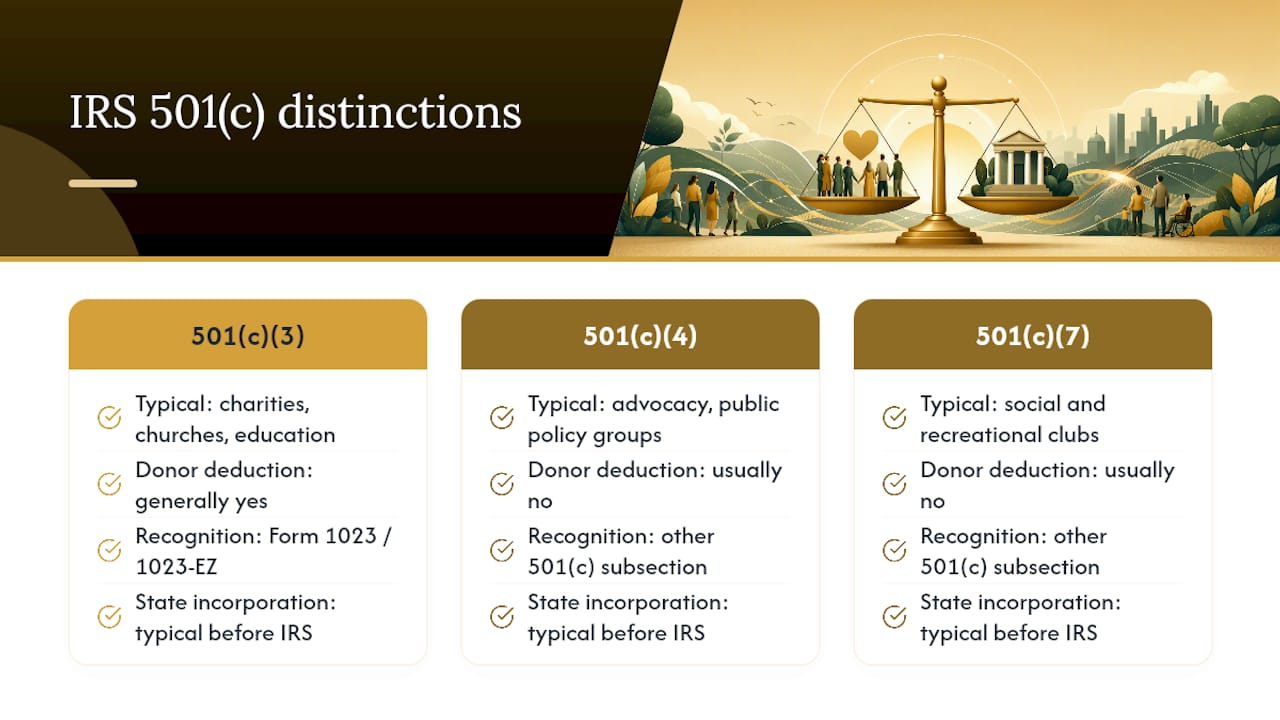
Section 501©(3) is the one most people mean when they say “nonprofit.” It covers charities, churches, and educational groups, and it’s the only common category where donors can generally deduct their gifts. Other sections, like 501©(4) for advocacy groups or 501©(7) for social and recreational clubs, are frequently what people mean by “not-for-profit.” Donations to these groups usually don’t come with a tax deduction, even though the organization itself may still be exempt from federal income tax.
Getting 501©(3) recognition means filing Form 1023, or the shorter Form 1023-EZ for smaller organizations, with the IRS. Processing typically takes a few months, sometimes longer if the application raises questions. Before that, most groups incorporate at the state level, which shapes liability protection and ongoing state filing duties.
Here’s a number worth sitting with: nonprofits are generally required to file Form 990 annually, disclosing revenue, expenses, and executive pay, while many not-for-profits face far fewer mandatory public reporting rules. That gap in oversight is often the clearest practical difference between the two labels, more than anything in their mission statements.
One more wrinkle: some groups that call themselves “not-for-profit” still qualify for tax exemption under a non-501©(3) category. The label you choose for your organization doesn’t decide your eligibility. The activity does.
Who Owns a Nonprofit? Nobody, and That’s the Point
Neither structure has shareholders. Nobody “owns” a nonprofit or a not-for-profit the way you’d own stock in a company, and that single fact reshapes everything about how these organizations operate. Surplus revenue gets reinvested into programs, not distributed as dividends.
Governance still needs a structure, though:
- Board-run charities are common among 501©(3) public-benefit nonprofits, with a volunteer board overseeing staff and strategy.
- Member-run associations are typical for not-for-profit clubs, where members vote directly on rules, dues, and leadership.
- Private inurement rules prohibit insiders (board members, executives, major donors) from personally benefiting beyond reasonable, documented compensation.
- Taxable subsidiaries sometimes get formed when a nonprofit wants to run a commercial venture (a bookstore, a licensing deal) without risking its exempt status, keeping separate accounting and arm’s-length contracts between the two entities.
Fair compensation matters more than most founders expect. Pay a board member or executive well above market rate without documentation, and you’ve created a private benefit problem that can draw IRS scrutiny fast.
Form 990 and the Transparency Gap Donors Notice
Most 501©(3) organizations with gross receipts above the smallest thresholds must file Form 990, a public document detailing revenue, expenses, and top salaries. Churches and a handful of other religious organizations are commonly exempt from this requirement, and state-level charitable registration rules add another layer that varies widely.
- Grantmakers routinely ask for Form 990s or audited financials before approving funding.
- State charity regulators often require separate registration before you can legally solicit donations there.
- Smaller not-for-profits with lighter federal reporting duties still need to check their own state’s registration rules.
Pro Tip: Publish your Form 990 or an annual summary on your own website instead of making donors dig for it on GuideStar. Groups that volunteer their financials upfront tend to build donor trust faster than ones that only comply with the bare minimum.
Choosing Between Nonprofit and Not-for-Profit: Your Checklist
Deciding how to structure your organization comes down to a handful of concrete questions. Work through them in order.
- Define your mission scope. Are you serving the public (education, relief, research) or serving your own members (a club, league, or professional network)? Public-benefit missions point toward 501©(3) nonprofit status.
- Map your fundraising plans. If you need donors to claim a tax deduction, you’re almost certainly looking at 501©(3). If funding comes from membership dues, other 501© categories may fit better.
- Weigh liability exposure. Incorporating at the state level generally shields founders and board members from personal liability. Staying unincorporated keeps paperwork lighter but can expose members to more personal risk.
- Decide on governance. Will a board run things, or will members vote directly? This shapes your bylaws from day one.
- File the paperwork. Draft articles of incorporation (or association documents), apply for an EIN, write bylaws, and file Form 1023 or 1023-EZ if you’re pursuing 501©(3) recognition.
- Consult counsel for state-specific rules. Registration requirements, annual report duties, and charitable solicitation laws vary enough state to state that a quick review with an attorney or formation specialist saves real headaches later.
Compliance Mistakes That Put Your Status at Risk
The fastest way to lose tax-exempt status isn’t picking the “wrong” label. It’s sloppy governance.
- Undocumented compensation. Pay insiders without a market-rate comparison on file, and you’ve created a private inurement problem. Keep salary benchmarking on record.
- Unrelated business income left unmanaged. Running a side revenue stream without tracking UBIT exposure can trigger unexpected tax bills. A separate taxable subsidiary often solves this cleanly.
- Skipped state registration. Soliciting donations without registering charitably in that state is a common, avoidable violation.
- Missing board minutes and no conflict-of-interest policy. Both are cheap to fix and heavily scrutinized during any IRS review.
Why the Words You Use Actually Matter
Founders mix up “nonprofit” and “not-for-profit” constantly, and honestly, who could blame them? Neither term is defined in the tax code. But the confusion has real consequences the moment you’re filling out Form 1023 or explaining to a major donor why their gift isn’t deductible.
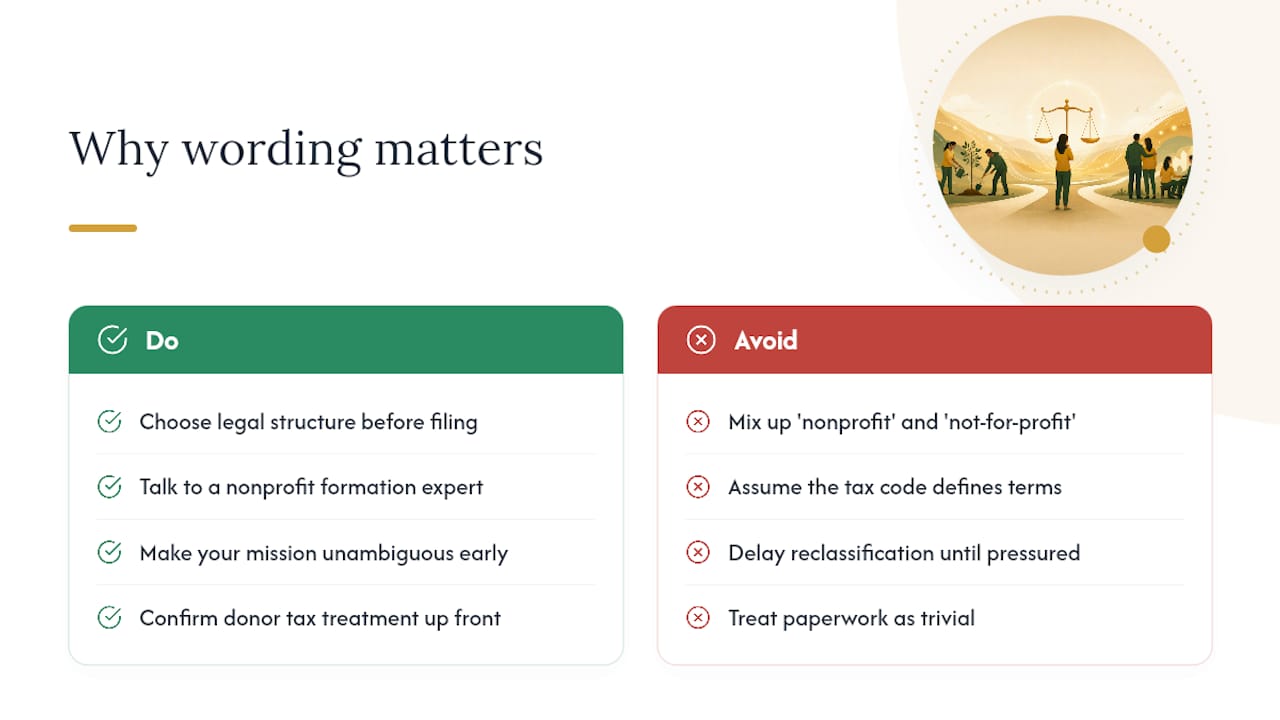
Getting the legal structure right at the start, before you’ve built a donor base or hired staff, saves you from restructuring later under pressure. That’s not a small thing. Reclassifying an organization mid-flight is expensive and slow.
If you’re still unsure which path fits, talk to someone who works in nonprofit formation before you file anything. The paperwork is forgiving. Ambiguity about your own mission isn’t.
— David
An Attorney-Backed Path Beyond the Standard Nonprofit Model
If everything above has you weighing member governance and asset protection over the heavier reporting load of a public charity, a Private Unincorporated Association (UNA) deserves a look. Unincorporatedassociations builds attorney-backed formation documents for exactly this structure, without the public registries or recurring state fees that come with an LLC or corporation.
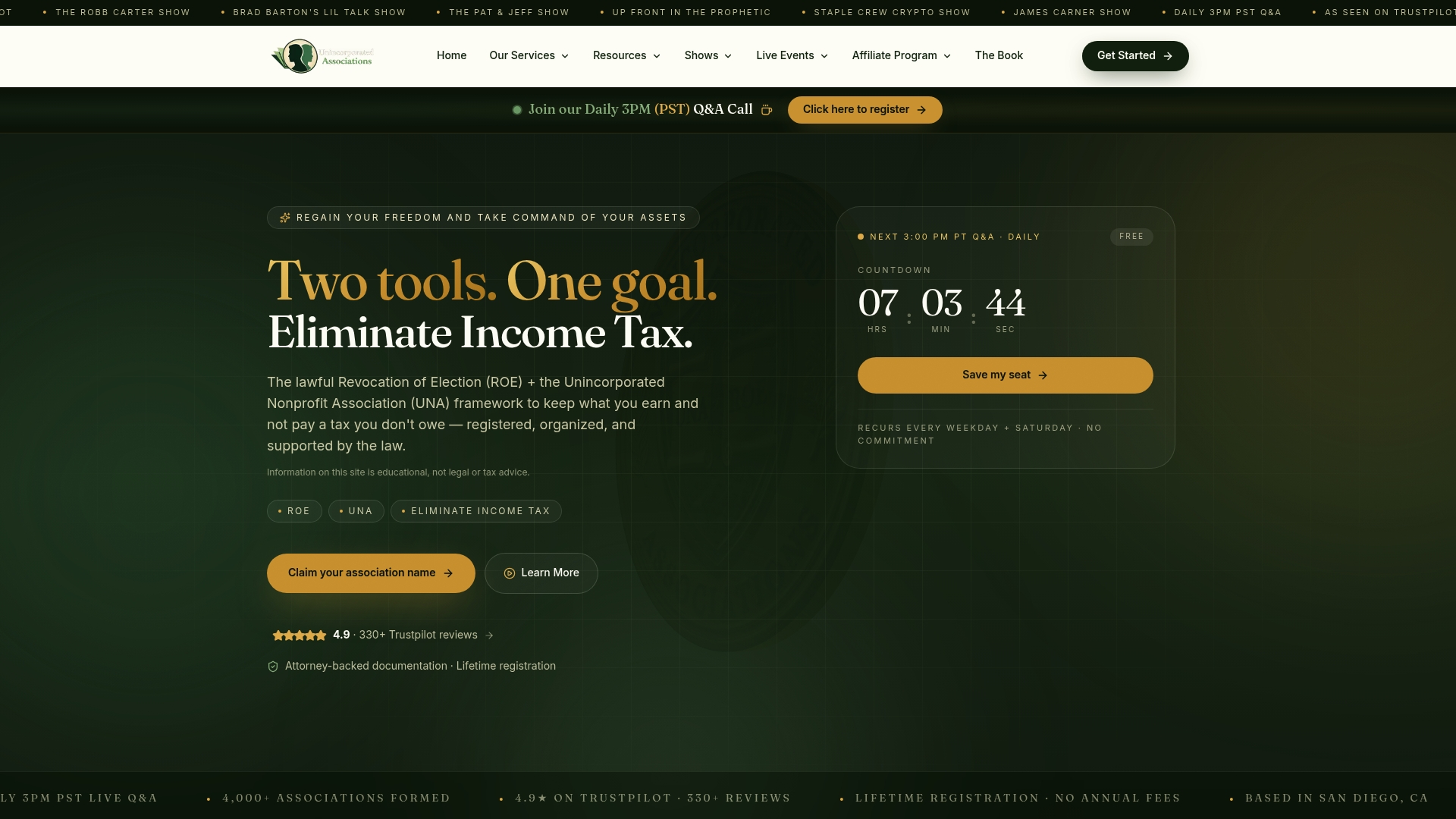
The UNA formation package includes state registration support, EIN assignment, Revocation of Election preparation, customizable association naming, and lifetime access to daily Q&A and a training library. It’s built for people who want member-based control over their assets, backed by real legal documentation, without wading through the state incorporation process solo. If a UNA sounds like the right fit for your goals, you can order the UNA + ROE package directly and get started with attorney-backed paperwork in hand.
Where to Verify These Rules Yourself
Primary IRS guidance on 501© classifications and Form 990 requirements is worth reading directly rather than taking any explainer’s word for it, including this one. The U.S. Chamber of Commerce and Forbes Advisor both offer solid plain-language breakdowns. Always check your specific state’s charitable registration page before filing, since those rules shift by jurisdiction.
This article is general information, not a substitute for advice from a qualified lawyer. Consult a qualified legal professional about your own circumstances before acting on anything here.
Sources
- Not-for-profit vs Nonprofit — Unity College blog
- Nonprofit vs. Not-for-Profit vs. For-Profit — U.S. Chamber of Commerce
- Nonprofit organization definition — Investopedia
- Not-for-profit vs. Nonprofit — Forbes Advisor
FAQ
Is it better to say nonprofit or not-for-profit?
Neither term is legally required. “Nonprofit” is the more common phrase for public-benefit 501©(3) charities, while “not-for-profit” is often used for member-focused groups, but the IRS doesn’t officially distinguish between the two labels.
What is the 33% rule for nonprofits?
This typically refers to the public support test some 501©(3) public charities must pass, requiring roughly a third of total revenue to come from public donations rather than a small number of large sources; specifics vary by organization type, so check current IRS guidance for your category.
Is there a legal difference between nonprofit and not-for-profit?
Not officially. The IRS classifies tax-exempt groups by 501© subsection, not by these colloquial terms, though in practice “nonprofit” usually means 501©(3) and “not-for-profit” often means other 501© categories with different donor tax treatment.
Which is better, nonprofit or for-profit?
It depends entirely on your goals. A nonprofit or not-for-profit structure fits missions built around public benefit or member service with no owner distributions, while a for-profit structure fits ventures built to generate personal or shareholder income.
Recommended
Have questions? Bring them to the daily call.
Join our live Q&A every weekday and Saturday at 3PM PST, or get a free 15-minute call to see whether a UNA fits your situation.
Have a question about your situation?
Send us a message and we'll get back to you.
Keep reading
 The Well-Meaning Dragon: Straight Answers to the Hardest ObjectionsFor the family and friends who push back because they care — honest answers to the toughest questions about the Federal income tax and Unincorporated Associations.
 It's Not What You Believe, It's What You SignFor the cautious partner in the room: real risk rarely comes from asking questions. It comes from what you signed.
 What Most People Get Wrong About Taxes, Structure, and ControlThe real problem isn't taxes — it's structure, and who actually has control. A look at positioning over loopholes.
Educational, not legal or tax advice. Unincorporated Associations is a document-preparation and education company. Consult a licensed attorney or CPA before acting on any position discussed on this site.