
Hold Title Privately as a UNA: When State Law Lets You in the U.S.
· 12 min read

Yes, a UNA can hold property in the United States, but the path depends entirely on where it’s formed. Some states have adopted versions of the Uniform Unincorporated Nonprofit Association Act (UUNAA) that let a UNA hold title directly. In every other state, the property has to sit with trustees or another legal arrangement. Attorney-backed documentation is what makes either route actually hold up.
TL;DR:
- A UNA can hold property directly in states that have adopted the Uniform Unincorporated Nonprofit Association Act, but elsewhere it requires a trustee or legal arrangement.
- Recording a statement of authority is crucial in some states to establish who can sign for the association, but it often expires within five years and must be renewed.
- In non-UUNAA states, property is typically held by trustees through a trust agreement, which depends heavily on proper drafting and internal rules.
- Forming an LLC or corporation may be necessary if the property carries significant liability, if a gift or mortgage is involved, or if statutory recognition is lacking.
- A complete, attorney-backed UNA formation kit costs $4,950 with no ongoing annual fees, serving as a cost-effective alternative to trustees or corporate structures.
Table of Contents
- How Does U.S. Law Treat Property Held By a UNA?
- What Are Your Options for Holding Property Under a UNA?
- How Do You Actually Transfer Property Into a UNA Arrangement?
- When Should You Choose a Corporation or LLC Instead?
- Why the “Just Form an LLC” Advice Misses the Point
- Ready to Put Your Property Under a UNA?
- Where to Verify the Statutes Yourself
- Sources
- FAQ
How Does U.S. Law Treat Property Held By a UNA?
Under old common law, an unincorporated association isn’t a “person” in the eyes of the law. It’s just a group of individuals who agreed to act together. That distinction sounds technical, but it has a real consequence: a group with no separate legal identity generally cannot hold title to property in its own name. Someone has to hold it. Traditionally, that someone is a trustee or a set of members acting on the group’s behalf.
The UUNAA changed that calculation for states that adopted it. Where the act (or something close to it) is on the books, a nonprofit association gains the legal capacity to acquire, hold, encumber, and transfer real and personal property under its own name, not a trustee’s. Most versions of the act also include a mechanism called a statement of authority, a recorded document that names who can sign for the association and what they’re authorized to do with association property.
Two states show how this plays out on the ground:
- North Carolina allows a nonprofit association to record a statement of authority for real property. The statute spells out indexing rules and gives that recorded statement a five-year shelf life before it needs renewal.
- Texas treats an unincorporated nonprofit association as capable of holding and transferring property outright, and Chapter 252 of the Texas Business Organizations Code offers optional filings, including a statement of authority and the appointment of an agent for service of process.
Statutory adoption is the hinge point here. Where a state has UUNAA-style language, the classic title and liability headaches largely disappear. Where it doesn’t, the workarounds still function, but member exposure and title uncertainty stay on the table.
That matters for anything requiring a signature on a deed, a mortgage application, or a title insurance policy. Title companies and underwriters want clean answers about who owns what and who can sign for it. A UNA operating in a UUNAA state can usually give them that answer directly. A UNA operating without one has to prove authority through other means, and not every county clerk or lender is equally comfortable with that proof.
What Are Your Options for Holding Property Under a UNA?
You have essentially three routes, and the right one depends on your state and how much property is involved.
- Direct statutory title. If your state has adopted UUNAA or similar language, the association itself can appear on the deed. This is the cleanest option where it’s available, since it removes the trustee layer entirely and gives the association standing to sue, be sued, and hold insurance in its own name.
- Trustee-held title. In states without enabling statutes, a trustee (or several) holds title on the association’s behalf under a trust agreement that spells out fiduciary duties, successor trustee provisions, and what happens to the property if the association dissolves. This is the older, more common structure, and it works, but it depends heavily on how carefully the trust language is drafted.
- Statement of authority as a bridge. Even in a workaround state, recording a statement of authority (where the law allows it) gives third parties a document to point to when they ask “who can sign for this group?” It won’t convert the UNA into a titled owner where the statute doesn’t allow it, but it solves a lot of practical friction at the closing table.
A fourth path worth naming honestly: converting to a nonprofit corporation or LLC. That gets you unambiguous title and a real liability shield, but it also brings public registries, annual filings, and franchise fees that many people form a UNA specifically to avoid.
Pro Tip: Before you assume you need a trustee structure, check whether your state has adopted any version of UUNAA. A quick search of your secretary of state’s website for “unincorporated nonprofit association act” often settles the question in five minutes.
If you’re still deciding whether a UNA fits your situation at all, our overview of how UNAs work walks through the fundamentals before you commit to a structure.
How Do You Actually Transfer Property Into a UNA Arrangement?
Getting property properly held by (or for the benefit of) an association isn’t a one-signature affair. Treat it as a sequence, and don’t skip steps just because they feel administrative.
- Confirm your state’s law first. Search for UUNAA adoption or a comparable enabling statute. If you’re not sure how to read the result, this is exactly the kind of question worth putting in front of counsel before you file anything.
- Pick your holding method based on what step one told you: direct statutory title, a trustee deed, or, if the property carries significant liability, entity conversion instead.
- Record what needs recording. That might mean a statement of authority, a trustee deed, or an agent-for-service appointment. Texas, for example, treats these as optional filings with their own recording fees and procedural steps.
- Get an EIN for the association if you haven’t already, and update insurance policies and title endorsements to reflect exactly who holds or controls the asset.
- Loop in the title company or escrow officer early. If they’ve never handled a UNA-related closing before, walking them through your documentation ahead of time avoids a scramble at signing.
- Write down your internal rules for future transfers and what happens to the property if the association dissolves, and keep accounting records that separate association assets from any individual member’s.
One detail that trips people up: a recorded statement of authority isn’t permanent. North Carolina’s version expires after five years, which means someone has to track the renewal date or risk the document going stale right when a buyer’s attorney asks to see it.
For a deeper walk-through of setting up the association itself before you get to the property stage, see how to become an unincorporated association.
When Should You Choose a Corporation or LLC Instead?
A UNA isn’t the right vehicle for every situation, and pretending otherwise does readers a disservice. A few signals should push you toward incorporation or an LLC:
- You’re in a common-law state with no enabling statute, and the property carries real liability exposure. Members can be personally liable for association debts and obligations in many of these jurisdictions, and a trustee structure doesn’t erase that exposure the way a corporate shield does.
- You’re expecting a gift or bequest. Historically, gifts and testamentary transfers to UNAs have failed in court because the association wasn’t recognized as a legal person capable of receiving them. Statutory recognition or entity formation protects donor intent far more reliably.
- You’re taking on a mortgage or commercial lease. Lenders and commercial landlords are often skeptical of statement-of-authority documentation, and recording rules like North Carolina’s five-year expiration and indexing requirements can create title gaps a lender won’t accept.
- The asset value or liability profile has outgrown the structure. A UNA holding a small parcel or a vacation cabin is a different risk calculation than one holding rental property with tenants and insurance claims.
Why the “Just Form an LLC” Advice Misses the Point
Most guidance on this topic jumps straight to incorporation, as if a UNA is a placeholder structure for people who haven’t gotten serious yet. That’s backwards. For a huge share of the people asking this question, the goal isn’t running a business. It’s controlling an asset privately, without a public registry attached to their name and without annual fees eating into what they’re trying to protect.
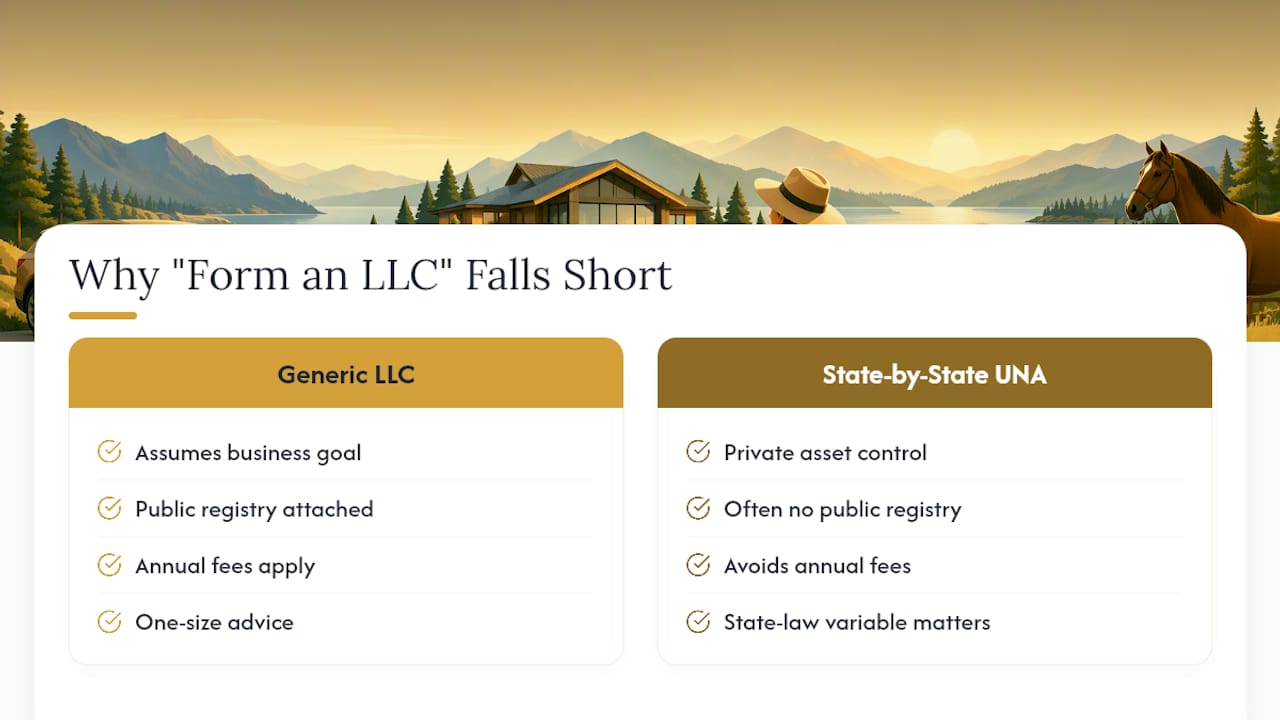
What gets underestimated is how much the state-law variable actually matters. Two people in two different states can ask the identical question, “can my association hold this property?”, and get opposite honest answers. That’s not a loophole. It’s the reality of a patchwork statutory landscape, and it’s exactly why generic advice fails here.
At Unincorporated Associations, our documentation is attorney-backed and built around this state-by-state reality rather than a one-size answer. Members have reported saving a collective total in the millions through proper structuring, and our Trustpilot rating sits at 4.9 stars from over 330 reviews. Those are the outcomes we track. I’m not going to pretend a UNA is the answer for every asset or every state, but for the reader asking whether it’s even legally possible, the answer is yes, more often than the conventional wisdom suggests.
— Kirk Carmichael
Ready to Put Your Property Under a UNA?
Unincorporated Associations is the direct alternative to hiring separate counsel to draft trustee deeds and statements of authority from scratch, because that documentation is already built into the formation package. The Full UNA package includes attorney-backed formation documents, a Revocation of Election (ROE) affidavit, filing guidance, and lifetime support for a one-time fee of $4,950, with no public registry entry and no recurring annual costs to maintain.
If you’d rather talk through your state’s specific rules before committing, you can book a consultation with an attorney first. Either way, state law is the deciding factor here, and getting a state-specific answer before you file anything is worth the extra step. When you’re ready, you can order your UNA + ROE package and get the formation process started this week.
Where to Verify the Statutes Yourself
Read the Uniform Act text directly, plus your state’s secretary of state guidance, before relying on any summary, including this one.
This article is general information, not a substitute for advice from a qualified lawyer. Consult a qualified legal professional about your own circumstances before acting on anything here.
Sources
- Uniform Unincorporated Nonprofit Association Act (UUNAA) — text and commentary
- North Carolina session law excerpt — nonprofit association property and statement of authority
- Information on Unincorporated Nonprofit Associations Under the Texas Business Organizations Code
- What is an Unincorporated Association and How It Works - LegalClarity
- What Is an Unincorporated Nonprofit Association? - Nolo
FAQ
Can an Unincorporated Association Own Real Estate?
Yes, but only outright in states that have adopted UUNAA or a similar enabling statute; otherwise, a trustee typically holds title on the association’s behalf. Texas and North Carolina both provide statutory frameworks that let a nonprofit association acquire and hold property directly.
What Happens to a UNA’s Property If It Dissolves?
Dissolution rules and governing documents typically dictate where assets go, and most UUNAA-style statutes include default winding-up provisions if the association’s own documents are silent. Without statutory guidance or clear internal rules, distribution can end up contested among members or trustees.
Do I Need a Statement of Authority to Buy Property as a UNA?
You need one only in states where the law recognizes and requires it as proof of who can sign for the association, and even then, it often expires and needs renewal, as North Carolina’s five-year rule shows. Some title companies will also want to see one even where it’s optional, simply for their own comfort.
How Much Does It Cost to Form a UNA With Attorney-Backed Documentation?
Unincorporated Associations’ Full UNA package is a one-time fee of $4,950 and includes formation documents, the ROE affidavit, and lifetime support. There are no published recurring fees beyond that one-time cost.
Is a UNA Safer Than an LLC for Holding Property?
It depends on the state and the asset. A UNA in a UUNAA state can hold clean title with less administrative overhead than an LLC, but an LLC generally offers a more universally recognized liability shield, which matters more as asset value and risk grow.
Recommended
This article is provided for general informational and educational purposes only and does not constitute legal, tax, accounting, or financial advice. Reading this content or contacting UnincorporatedAssociations.com does not create an attorney-client, CPA-client, or other professional-client relationship. In accordance with IRS Circular 230, any discussion of federal tax matters herein is not intended or written to be used, and cannot be used, for the purpose of avoiding penalties.
Have questions? Bring them to the daily call.
Join our live Q&A every weekday and Saturday at 3PM PST, or get a free 15-minute call to see whether a UNA fits your situation.
Have a question about your situation?
Send us a message and we'll get back to you.
Keep reading
 The Well-Meaning Dragon: Straight Answers to the Hardest ObjectionsFor the family and friends who push back because they care — honest answers to the toughest questions about the Federal income tax and Unincorporated Associations.
 It's Not What You Believe, It's What You SignFor the cautious partner in the room: real risk rarely comes from asking questions. It comes from what you signed.
 What Most People Get Wrong About Taxes, Structure, and ControlThe real problem isn't taxes — it's structure, and who actually has control. A look at positioning over loopholes.
Educational, not legal or tax advice. Unincorporated Associations is a document-preparation and education company. Consult a licensed attorney or CPA before acting on any position discussed on this site.